Thursday, July 21, 2022

North Wales Pilgrims Way - Stage 10 (Nefyn to Llangwynnadl)

Oh dear -slipped again!
If only I'd seen this before I set off down the cliffside. On the OS map there looked to be a clear right of way footpath down to the beach - Skip and I would trundle down and have a pleasant flat beach run for the first section of our day's pilgrimage from Nefyn westwards. The problem is that this section off coastline is subject to periodic landslips due to the friable nature of the hillside - this photo is from just a few years ago and of course this meant that our long established footpath had been eliminated leaving us scrambling about on a very unstable hillside amidst brambles, etc. Skip was quite discomfited! So back up we went having lost quite some time out of our allotment for the day.

Llyn Clifftops!
We managed to drop down onto the next beach and had a pleasant jog along the strand but we were then faced with a climb up to Nefyn Golf Course which must be one of the most exposed courses in Wales. A stiff breeze faced us on the cliff tops and the constant ups and downs as we progressed from inlet to inlet on the narrow paths became somewhat wearing. To add to our troubles a steady fall of rain worked its way through my waterproof top and even Skip lost his usual zip. At our rendezvous some miles further on near Tudweiliog I sat in the car, ate an early lunch and took stock. Vicky very kindly trekked over to the cafe to fetch me a hot cup of tea. Suitably invigorated I decided to press on using the alternative inland route minus Skip. It couldn't get any worse I thought!!

A picture postcard setting!
Porth Towyn is the beach closest to Tudweiliog. I'd been here before but not for 41 years. I'd hitchhiked up in a hot early September following the Isle of Wight Music Festival (highlights included Bob Dylan being booed for his being more electric and less folky than before). I'd been travelling on back roads sleeping at night under hedges in an extra-large fertiliser bag. On arrival I promptly fell asleep on the Towyn beach and woke up with a sore red nose! It certainly wasn't picture postcard weather today as I emerged from the car into the gale and  slogged the last few miles to our AirBnb at Llangwynnad just an hour or so short of the Pilgrims Way endpoint at Aberdaron. We already knew that our ferry to Bardsey Island had been cancelled due to the foul weather so our journey is not yet complete - we fight another day.

Sunday, June 26, 2022

North Wales Pilgrims Way (Stage 9 - Clynnog Fawr to Nefyn)


Big church!
 The population of Clynnog Fawr is round  about 1000. So what's a big church like this doing here? We've seen cathedrals not much  bigger than this. Well it was a rather  important staging post for the medieval  Welsh pilgrims on their way to Bardsey  Island. The church is dedicated to St Beuno  who lived here and there's a holy well just outside town where the pilgrims could  bathe their sore feet.

 
Well well!
And here's the well itself which I found on my way out of the village. This is one of a number of Welsh holy wells ascribed or dedicated to Beuno, maybe he had connections at Dwr Cymru. The signboard explains that the waters of this well are a cure for epileptic children  and in medieval times folk would bring their affected offspring from miles around and fling them into the icy water. I can see how this might work perhaps! (My trusty rucksac has also found it's way into the picture to prove I was there!) From here it's a fairly direct route parallel to the main road before dropping down into Trefor where Skip and then I faced the big climb up towards the three summits of Yr Eifl. Our path upwards was clearly centuries old and has been used by pilgrims, quarry workers and shepherds over the years. It was a clear calm day and, away from the traffic noise, we began to relax and enjoy the far reaching views down the length of the Lleyn peninsula. Our route widened out into a track along which granite was transported from the high quarries down to the sea at Nant Gwrtheryn which is the modern name for Porth Nant.


Not my photo but I think this is a stunning snap of a quite extraordinary location, the former isolated village of Porth Nant which was the export outlet for vast quantities of granite setts quarried further up the hill in the 19th and 20th centuries. These cobbles for the roads of Manchester, Liverpool and further afield were chiselled to size in the quarries and then transported down a zig-zag winding track (known as the Screw!) to the coast;  they were then loaded into steamers which carried their cargos up the Mersey and the Manchester Ship Canal to the newly built Coronation Streets and Penny Lanes of the late 19th century. Though very isolated Porth Nant was a thriving community, however after the second world war, tarmac became the road surface of choice and the cobble industry declined. The village was gradually abandoned and the dwellings fell into disrepair. However a forward thinking GP from Manchester, whose mother was Welsh speaking, had practised in North Wales and developed a strong Welsh affiliation to the extent that he set about reviving the village - it's now a busy residential Welsh Language centre, a new tarmacked (!) road enables vehicles to descent the steep tour down and the ruined buildings have been restored for accommodation for the students. It's a lovely spot and Skip and I were delighted to see the wonderful views as we wound our way down the 'Screw'.  

Little church!
We had a good look at the harbour and imagined the tramp steamers loading up their cargos of cobblestones and then proceeded on and upwards on the coastal path, the only other route out of Nant Gwtheryn which follows a cliff top route for a few miles. Having started the day by St Beuno's Church in Clynnog Fawr, we finished several hours later in Nefyn and, on the way down at Pistyll we were pleased to see yet another St Beuno's Church. This one is a much smaller building, apparently this is where Beuno went when he wanted a bit of peace and quiet. It's in a lovely spot overlooking the sea and, I learnt that it had a thatched roof until the 20th century, although all the photos I found depicted its current slate roof. A more recent claim to fame is that the churchyard contains the grave of Rupert Davies who played Inspector Maigret in the 1960's TV series. 

We're getting closer to the end of the pilgrimage, the historical links are more frequent and we seem to be moving further away from civilisation and the 21st century. Running away from the present perhaps? Well why not!


Monday, June 6, 2022

North Wales Pilgrims Way (Stage 8 - Waunfawr to Clynnog Fawr)


Any more fares please?
In London the buses are red, in Cardiff the buses are orange and blue but in Waunfawr the local bus company, Whiteways, painted their buses white of course! Here's a Whiteways double decker in Caernarfon some years ago. It must be some years ago because the Hepworths shop in the background would have disappeared over twenty years ago (the clothing chain changed its name to Next) and Waenfawr (see the destination indicator on the front of the bus) changed its name to Waunfawr in the 1990's thanks to the insistence of the Welsh Language Society. Setting off from Waunfawr on the next leg of our pilgrimage, it was a bright morning as Skip and I tootled past the Welsh Highland Railway station and up by Moel Smytho, across the broad hillside, under the shadow of Mynydd Mawr and on towards Y Fron.

The Blue Lagoon!
As we then left the wild upland spaces we began to encounter a landscape defined by the slate quarrying industry of the Nantlle valley. Virtually all of the quarries are now closed; however to get a real sense of the enormous extent of the industry requires a walk (or run in our case) through the vast area covered in spoil tips and ruins of pump houses and workshops heading down to Talysarn and Penygroes. Here's one of the flooded quarries above Y Fron, in this case coloured a brilliant blue thanks to mineral salts in the water, the fence between us and the cliff edge didn't seem very robust! There's a white buoy on the surface of the water (the Prisoner comes to mind!) and I think that's a crow flying overhead - the beak looks a bit small for a Raven.


The Cornish Beam Engine house at Dorothea Quarry
The UNESCO list of World Heritage Sites makes for interesting reading, included as might be expected are the Taj Mahal, Stonehenge and Venice and its lagoons, there are National Parks and archaeological sites aplenty and some sites have been delisted for various reasons (e.g. Liverpool). But there are less obvious choices on the list such as the Bikini Atoll Nuclear Test Site, the Fray Bentos Industrial Landscape in Uruguay and our current whereabouts, the Slate Landscape of North West Wales!

It would take days to thoroughly explore this area and the map below shows the vast area covered by the quarry workings which are criss crossed by footpaths and old railway lines. We jogged down from the top right of the map skirting the northern edge of the biggest flooded pit shown and by the entrance to Tal y Sarn Hall into the village itself where huge quantities of slate were loaded onto the main freight line to Caernarfon to be shipped around the world.


Fancy a drop?
Talysarn now seems quite a sleepy place, on a warm May afternoon I spotted little traffic and just a couple of pedestrians,  surely a contrast to a century ago when it was a hive of industry. The old train station is the site of a bus terminal and the railway line out of town has been replaced with a by-pass. However new industries are springing up - look at this - a Welsh vineyard between Talysarn and Penygroes! Thousands of vines and apple trees have recently been planted for the production of wine, cider and apple juice - this includes 700 trees bearing the rare Bardsey Apple a rediscovered variety probably the survivor of trees planted by monks on Bardsey Island a thousand years ago.  Alas we had no time to stop and sip and stare and we carried on the remainder of our jaunt from Penygroes to Clynnog Fawr which was, by contrast, through rolling farmland. Two consecutive days of long running had tired us out and we needed to rest and recuperate.

Wednesday, May 25, 2022

North Wales Pilgrims' Way (Stage 7 Bangor to Waunfawr)


Not the biggest cathedral I've seen!
Well isn't it funny how time slips away!    After a few weeks of cross country, half marathoning and Borders Leagueing I finally got back to getting moving again running along the Pilgrims' way. And guess what? There are now leaves on the trees and I'm wearing shorts. Vicky dropped me off where I left off previously and I shuffled into Bangor - here's the comparatively modest cathedral. This is dedicated to St Deiniol. Deiniol is a name that I was already familiar with as there was a young footballer named Deiniol Graham who was one of Alex Ferguson's rising stars at Manchester United. He was going well until he broke his arm and never played again for United. I suspect he lives somewhere round here (in the Prestatyn area) as he recently got a mention in the local newspaper in relation to a motoring offence! Apparently the reason that the cathedral has such a short stubby tower is that the locals didn't want it to be visible from the sea - at the time Viking raiders were on the prowl looking for booty and it didn't pay to advertise your presence! Just after I took this photo I was hailed unexpectedly in the middle of Bangor by our friend Lynne plus daughter and friend who had also come over from Prestatyn to walk a section of the Pilgrims Way.  

They'd selected a fairly gentle start to their day as in the early stages out of Bangor, after an initial climb, the trail then follows Lon Las Ogwen which is a lovely cycle route built on the old Penrhyn Quarry railway line. For about 4 miles Skip and I followed this fine avenue of maturing trees feeling strong on this pleasant morning.. 

Organic farming in the round!
This was a great opportunity for me and Skip to get well ahead of the girls and we galloped along at a brisk pace. Leaving the old railway line we found ourselves at Pandy Farm, a large circular enclosure with farmhouse. This aerial photo shows what it looked like at one stage but it's rather overgrown now. If you imagine this as a clockface, Skip and I were having a breather in the stream by the trees at about twenty past; refreshed we carried on but made a serious error. About a mile further on I realised I'd left his lead by the stream. We trudged back to be met by Lynne and Co who'd caught us up! So retracing our steps we went up and up through the forest, onto the open moorland and over into the valley where sit Llyn Padarn and the busy town of Llanberis.

Here's Christ Church in the small village of Deiniolen (pop. 2,000) overlooking the lake. Coming off the mountain trail I'd lost my bearings for a minute or two, Deiniolen is riddled with public footpaths, a legacy of the slate industry, so it's easy to take the wrong route. The lofty church spire beckoned us however and we ran down a narrow path at the back of the cemetery and took this snapshot. Looks a bit more imposing than Bangor Cathedral I think,  although it's not an old church, it was built in 1857. In other words it doesn't have much in the way of pilgrimage connections! And so we continued down to Llanberis, past the railway station where a nice looking steam train puffed to a halt disgorging its load of tourists and round the bottom of the lake into town. A familiar  voice from behind us announced the arrival of Matthew on his bike. Matthew is an old running friend who lives not too far away and it was a nice surprise to bump into him and have a brief chat. Glad of the few minutes respite we set off on the final tough leg of the day's journey up and over to Waunfawr. That final track seemed to go on forever - 32K of yomping had certainly taken it's toll on our legs


Thursday, February 10, 2022

North Wales Pilgrims' Way - Stage 6 (Llanfairfechan to Bangor)

Let's try again Skip!
Well what a disaster, so I thought; I got out of the car at Llanfairfechan to set off on our latest leg of the Pilgrims' Way and realised that we'd left Skip's lead at home. The only thing for it was for me to set off solo up and over the tops and down to Abergwyngregyn (fortunately this was part of the prescribed route). Vicky managed to nip into Bangor and buy a new collar and lead for the boy. This she did with aplomb and thus, an hour later, I set off again with Skip in tow (or was he towing me?) It had been curiously lonely running without Skip for the first time on our trek.


Where's the whisky?
 Off we trundled up to the Aber Falls, which in the rainy season (much of the year up here I think) is quite spectacular and my photo of the main drop doesn't really do it justice. A torrent of water hurtles down the steep cliff - where were the thousands of visitors come to watch this force of nature?We did however come across a lady at the foot of the waterfall who seemed to be simultaneously taking a video and chatting in an Asian language; she was apparently unaware that she was missing the chance to interview a champion international mountain runner and his dog. Gosh we could have been featured on Japanese prime time TV! We didn't see the Aber Falls Whisky Distillery which according to the website "sits at the foot of the famous waterfalls" - it's actually back in the village on the north side of the A55, after being a slate works the distillery was a margarine factory for many years! It all adds to the taste. That's a slightly unfair comment because we haven't tasted Aber Falls whisky yet - but if anyone wants to buy us a bottle...!


I'm not jumping over one of those!
Much of today's route was into a fierce wind, at some points I seemed to be running on the spot against a howling gale. But we gradually made progress and the going was good - much of it was on what was clearly an ancient track on the mountain running parallel to the A55 which we could see far below us. Puffin Island was off in the far distance! There wasn't much else to see up here but as we headed down on the last leg there was more to entertain us. Having been a part time dry stone waller in several locations over the years, I'm always interested in the different techniques that wallers use from place to place. This is generally dependent on the materials at hand, I've built walls with limestone and gritstone in the Derbyshire Dales and I've marvelled at wonderful durable walls made of stone but no mortar in various parts of the UK, Ireland, Tasmania and the North East US. Snowdonia wallers over the years have come up with innovative fencing solutions using local slate - this photo taken a couple of miles above Bangor says it all!

Nice VW pickup! Didn't make those in 1465.
On the tracks heading downhill to our end of run rendezvous, I spotted what appeared to be an ancient converted church. Having not seen much in the way of churches today I thought I'd take a photo and investigate when we got home. It turns out that this wasn't a church at all but a medieval manor house dating from the 15th century called Llys Hynafol Cochwillan. It's recorded that this was originally the home of the sheriff of Caernarfonshire and was subsequently owned by a number of notables including the Duke of York! It then fell into decay and was being used as a hay barn in the 1960's before being restored - it now looks to be quite a nifty upmarket dwelling!

So that's another stage complete - in an ideal world we'd have finished at Bangor Cathedral to round things off nicely. But it was after lunch, I'd not made any butties to pack in my rucksack and I was glad to finish at Llandegai just short of Bangor to meet Vicky who very kindly met me with a  tasty sausage sandwich. Very prosaically she had parked by a good sized industrial estate and she'd guessed that she might find a reliable cafe; and indeed she found one staffed by a couple of middle aged local ladies who, just after 2 pm, owned up to still being open for her. 


Sunday, January 16, 2022

North Wales Pilgrims' Way - Stage 5 (Eglwysbach to Llanfairfechan)

I'm waiting!

So the forecast was for a dry bright morning. As we drove along the A55 the rain intensified, our windscreen wipers flashing across the window at top speed. We revised the day's plan, from Eglwysbach I would run as far as Rowen and have a rain check there! At least we would have crossed the Afon Conwy which would feel like a significant achievement. Skip didn't seem worried one way or the other as we set off down a watery track spotting a large piece of slate perched on some rocks with an interesting handrail. What could this have been? A bus stop? On our return to Eglwysbach sometime this summer - to go and have a pint in the Bee Inn of course - we must ask if any of the locals know what this was for. We slogged onwards towards Rowen, the rain showing no sign of abating.


But there's no one here!
The sky seemed a little less grey by now and descending into Rowen village things looked slightly more positive. At the rendezvous with our wonderful driver Vicky, we decided to press on. Of course half a mile out of the village the heavens reopened, there was nothing to it but to crack on upwards onto the hills. At the top of a particularly steep climb (about 200m in 1.5K) we came across the remarkable ancient church of St Celynnin. Apart from one property a few hundred yards away there's not much else around here as far as human habitation goes so there's no regular worship taking place. However the church is still in use, what's more a female priest was ordained here fairly recently by the Bishop of Bangor. Apparently Bangor Cathedral was unavailable due to COVID restrictions so Bishop and novitiate together with one or two guests hiked up the mountain to perform the relevant ceremony. I nipped inside to say a prayer and sign the visitor book on behalf of Skip and myself and returned outside to find that the rain had disappeared!

Wind and rain outside - peace and quiet inside.

Where are they all going?
We started to make good headway across the tops, I knew some of these tracks from the various fell races that take place over these hills. The Tal y Fan race from Rowen and the Penmaenmawr Fell Race in particular are known for runners misdirecting themselves, in the low mists that are common up here it's easy to go wrong and I have been slightly guilty of this myself in the past. With map and compass at the ready I was well prepared - but the air was clear, the sky was blue by now and we found our way. The photo is evidence of the criss crossing pathways up here, several of which converge near the Penmaenmawr Stone Circle one of many prehistoric ceremonial and burial sites which litter the hillside. (Why did so many folk live up here at that time? Perhaps it was warmer back then!) So on this way-marker post we can see advertised the North Wales Pilgrims' Way, the North Wales Way, a Conwy Trail and the Wales Coastal Path, although we are well away from the coast right here. I won't ask any more questions.

Our day's ramble finished with a steep descent to the Nant y Coed Nature Reserve at Llanfairfechan. Closed at the moment due to fallen trees blocking access it nevertheless looks a pretty spot and has been appreciated by visitors for over a century with its waterfalls and stepping stones and varied wildlife. It's known in particular for its population of sessile oak trees. This are just like regular oaks but the acorns are not on stalks, rather they are attached directly to twigs - this picture shows how it's done (it's not my photo, wrong time of year!) At the entrance to the nature reserve was an informative signboard in Welsh and English, I was puzzled however by the comment that overhead "you may hear the mewing of the vulture-like buzzard"! I suppose that this means that most of today's visitors are more familiar with vultures rather than buzzards - too much TV perhaps?


Monday, January 10, 2022

North Wales Pilgrims' Way - Stage 4 (Gwytherin to Eglwysbach)

Been stuck here for days - help!
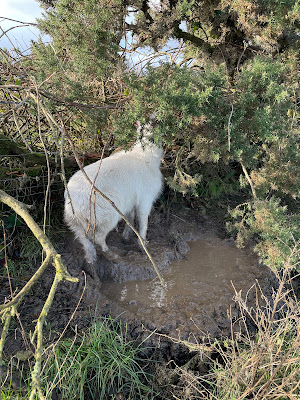
A brighter morning to start with and we had a pleasant climb out of Gwytherin up a lovely path in a wooded valley, all good so far. Skip and I encountered a couple of fallen trees which we spent a bit of time skirting round. Then, as we crested the top of the hill the heavens opened - we got wet....and muddy. Tramping over a moorland plateau I realised I'd been wise to pack dry socks. A quick downhill and a short road section saw us onto some very wet fields. I keep Skip on the lead when there are sheep around but let him off otherwise - and there we were, in a flourishing green field with no sign of grazing animals, I spotted movement in a hedge. A young but large lamb was standing in a big muddy puddle with its head stuck in fencewire; its backwards facing horns were preventing any escape. I extricated it with some difficulty and it bleated at me with gratitude, its backs legs sank to the ground and it started munching on a big tuft of grass. Clearly it had been there for some time - we were nowhere near a farmhouse so I had to leave it to fend for itself. Having kept sheep in the past I was confident that it would recover and retain a memory of that gallant pilgrim who had saved its life.
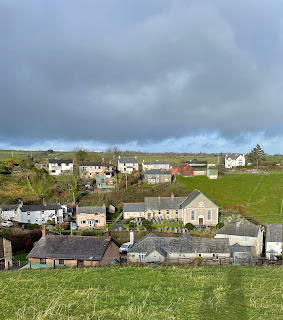
Pandy Tudur - anyone here called Andy?
We headed onwards through a small village going by the name of Pandy Tudur, the word Pandy referring to the fact that there was a pre industrial woollen mill here. At this point the rain stopped and the village was bathed in sunlight. The largest building seen here is the Bethania Calvinist Methodist Chapel. Unlike Amglican and Catholic churches, which are generally named after saints, Methodist chapels are named after biblical locations and Bethania or Bethany is just a couple of miles outside Jerusalem - it's where Jesus raised Lazarus from the dead. Out of Pandy Tudur we climbed along past a farm on the outskirts of the village and were serenaded by half a dozen collies who raced backwards and forwards on the other side of a fence clearly trying get a rise out of Skip, but to no avail, Skip ignored them and we carried on up and over the hill.
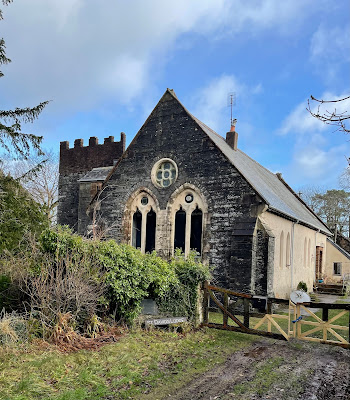
Anyone at home?
I had seen that the map indicated an old vicarage was coming up on our right. So by a vicarage you'd expect a church and indeed here is a church,  but it's a church no longer. I've been unable to find out much about it apart from the fact that it was built in 1867, which leads me to wonder who built it and who were the congregation, seeing as this was sited well away from the village. By the front gate is a wooden sign with St David's Lodge written on it so presumably that was to whom the church was dedicated. Next door is a large ruined vicarage which functioned as a nursing home until 2019 when it burnt down. The local fire brigade did well to get all the residents out without any major casualties!
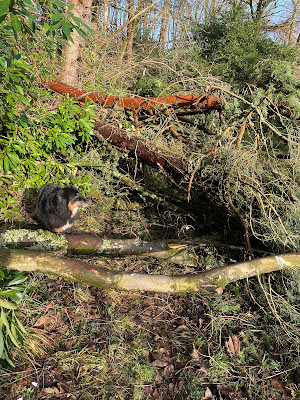
Bring me chainsaw next time!
We'd been making fair progress at this point but our hopes of keeping going at a fair lick were dashed as we negotiated a woodland riverside path by the grounds of Hafodunos Hall. The hall, one of the most majestic residential buildings in Wales, was burnt down in 2004 but is currently being rebuilt; we'll have to go and take a look when it's completed. We trotted along comfortably on a well defined path, turned a corner and came face to face with this - a mass of trees had fallen directly across our way. We tried going up and round with no success, Skip getting snarled up in the tangled undergrowth. Eventually we backtracked to a fordable crossing point through the river and made our way round. This whole episode had cost us nearly half an hour.

Back on the trail we picked up our heels and to help us on our way we were pointed in the right direction by a kindly old woodman:
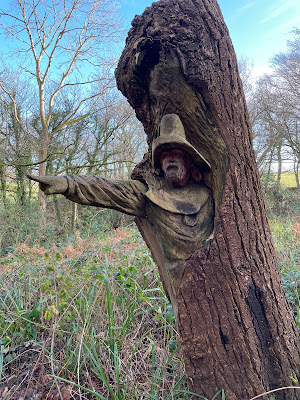
It's this way buddy!

Gurgle!

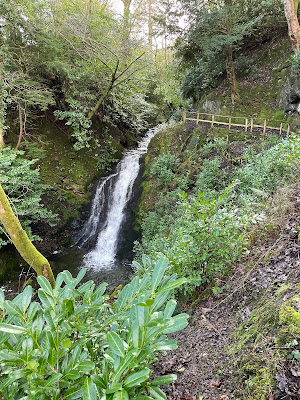
Heading into Llangernew we tracked the river further downhill and were rewarded with a pleasant amble through mature woodland spotting a gushing waterfall to our right. We passed the old hall gatehouse and trotted down the road. I had already realised that there was a lot to see in Llangernw, including the North Wales Pilgrims' Way Hub, and St Digian's Church with a 4000 year old yew tree in its graveyard. With little time to spare I decided to consign all this to a future visit and we stuck to the Pilgrims' route and galloped up the hill just before the village. At the top of a short climb a big metal gate barred the way forward. It wasn't padlocked but it might as well have been. A tightly knotted rope secured gate to post and no amount of teasing could unravel the contorted tangle. So for maybe the fourth time today I lifted Skip up and heaved him over.
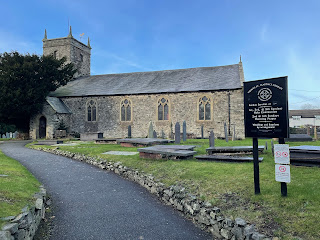
St Martin was here!
From the final peaks of the day we could see Snowdonia in the distant west, on a clearer day this would have been a magnificent sight as we descended down the steep tracks and roads into Eglwysbach. We passed Coed Annie (no idea who Annie is or was) and along the Afon Hiraethlyn onto our final rendezvous outside the Bee Inn, a fine looking pub. It's now the only pub in town but a hundred years ago there were plenty - in 1909 there was an objection to the renewal of the licence for the Bodnod Arms next door on the grounds that there was currently one pub for every 185 inhabitants, the pub failed to have its licence renewed but it then became the Aberconway Institute for use by the community, courtesy of the owner Lady Aberconway. I finished the day outside St Martin's church close to the Bee Inn. No dogs allowed inside the pub though - maybe we can come back in summer and have a pint in the beer garden, the beer should be good - each week the locals select a guest ale of their own choosing to sit on the bar next to the Bee Inn Bitter.


North Wales Pilgrims Way - Stage 10 (Nefyn to Llangwynnadl)

Oh dear -slipped again! If only I'd seen this before I set off down the cliffside. On the OS map there looked to be a clear right of way...